
Female athletes have been grossly underpaid since the origin of women’s professional sports in the late nineteenth century. Those who criticize women’s sports have chalked this up to it being a ‘bad product’ with low viewership. However, this is a lazy argument that the Women’s National Basketball Association is quickly disproving. According to an official press release from the league, “The WNBA delivered its most-watched regular season in 24 years, finished with its highest attendance in 22 years and set records for digital consumption and merchandise sales in 2024.”
The WNBA continues to set new viewership records, averaging 1.19 million viewers across regular-season games in 2025 (WNBA 2). For context, in the same year, the National Hockey League averaged 584,000 viewers across platforms. While it is true that the NHL generates a higher revenue, the viewership, and on a broader scale, the product of women’s sports, is not the issue. The issue is the leadership.
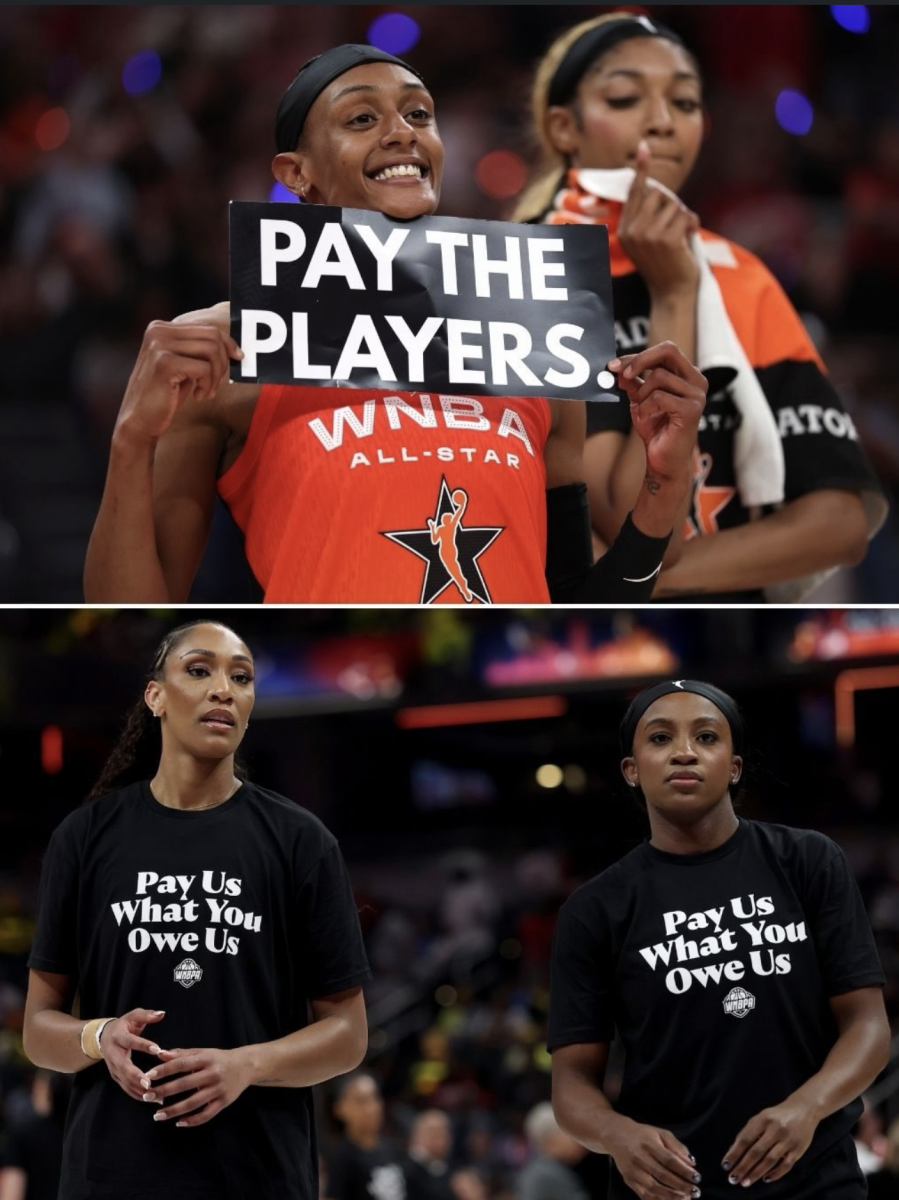
The WNBA has built a high interest product on the backs of its players, but refuses to pay them an equitable percentage of the profit. In order to grow into a self-sufficient league, it must take responsibility and compensate players proportionally to their involvement.
The WNBA currently operates under a Collective Bargaining Agreement (CBA), which is typically renegotiated every four years. The CBA is a document that outlines players’ salaries, as well as policies for how the league is governed. It is negotiated and agreed upon by the WNBPA (Women’s National Basketball Players Association), a democracy composed of the players in the league. The last CBA was signed in 2020 and is currently being renegotiated. However, due to the drastic growth in the WNBA over the last 6 years, players are expecting proportionate rises in their income. They have not received that same respect.
As reported by Jackie Powell for NBC Sports, the WNBA currently allots players only 9% of the league’s total revenue in salaries, compared to roughly 50% for their NBA counterparts. Even accounting for differences in revenue and operating costs, the scale of this discrepancy is not only an economic shortcoming, but also an insulting failure by the league’s administration.
The WNBA is offering to increase the player salary cap to 14% of the total revenue, arguing that all other money is used to benefit the players with luxury accommodations. Yet, representatives for the WNBPA argue the exact opposite in a released statement: they can best benefit the players by directly increasing their salary, “The players propose getting 30 percent of $350 million in total revenue, which would yield them $105 million for salaries and benefits” (Powell 12).
This simple disagreement yields a $56,000,000 discrepancy in players’ compensation. Considering that number, it is obvious to see why this negotiation has continued for over a year, with no end in sight. Nonetheless, if a compromise isn’t reached soon, there is a risk of the 2026 season going on strike, which would be counterintuitive for both players and leadership.
Despite this, the players are not backing down, and rightfully so. The WNBA must evolve with the times and commit to paying players a livable wage that allows them rest in the offseason. Currently, many players are forced to play overseas in order to make ends meet. This is a unique reality solely for female athletes, whose labor is constantly disregarded and insufficiently compensated.
With equitable payment the WNBA would benefit from healthier, well-rested, and more energized players. But the WNBA has failed to enact these changes once again.
There is no league without the players. It is time to pay them accordingly.